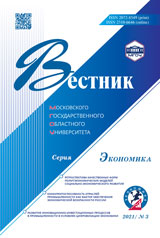
The journal “Bulletin of the State University of Education. Series: Economics” is included into the list of Higher Certifying Commission (НСС) in economics for the following scientific specialties:
5.2.1. Economic theory (Economic sciences),
5.2.3. Regional and sectoral economy (Economic sciences).
The journal is devoted to fundamental and applied research in the sphere of economics and management for the following scientific specialties, as well as to the analysis of general economy problems and scientific-practical research in economics and management of national economy.
The journal also widely covers vital questions which reflect the development of financial-economic processes taking place in Russia and abroad.
The journal makes reviews of scientific research and publishes scientific articles in the sphere of theory and practice of economy and management, organizes productive dialogue on a wide range of economic and managerial questions, ensures the opportunity to exchange information for a wide circle of scientific community, forms scientific space for discussions, and also provides the presentation of scientific degree searchers’ research.
The edition organizes broad discussions on the problems of the development of economic theory and management, and on the effective forms and methods of managing organizations and enterprises, contributes to the spread and productive exchange of knowledge in these spheres.
The journal is addressed to domestic and foreign scientists, lecturers of higher and secondary educational institutions, as well as to young scientists interested in vital problems of economy and management.
Audience: students, post-graduate students, doctoral candidates and lecturers of universities, scientific workers, analysts, heads of state and economic bodies, of organizations and enterprises, bank specialists, investment and insurance companies.
Current issue
ECONOMIC THEORY
Aim. Quantitative assessment of the inflationary effects arising due to the high level of the key rate in Russia.
Methodology. The key research methods were statistical and comparative analysis. The labor market and the mechanism of inflationary expectations formed under the influence of external production and consumption shocks were analyzed.
Results. Quantitative assessments of the impact on inflation of increased production costs and growing inflationary expectations of businesses and the population due to the high key rate were obtained.
Research implications lies in the quantitative understanding of the mechanisms of reflection of external shocks of consumption and production in the economy, which allows for better consideration of them in the forecasting of their activities by enterprises and other economic agents and, as a result, to reduce the time of reaction to an external shock and the inevitable increase in costs during this period.
REGIONAL AND SECTORAL ECONOMY
Aim. The study is devoted to the development of a methodological framework for determining the standards of labor intensity and cost associated with the creation of scientific and technical products.
Methodology. They include a methodological apparatus for determining labor intensity standards, as well as an array of information containing in a systematic form the initial data for determining labor intensity standards, the experience of leading scientists and specialists in assessing labor intensity and cost of work, and the results of an analysis of publications on human resource management
Results. The results of the work are the basic provisions of the methodological apparatus for determining the standards of labor intensity and cost of work related to the creation of scientific and technical products.
Research implications. The implementation of the results of the work in the practice of industry organizations will increase the level of validity of the standards used to justify the complexity of research and development work and will contribute to improving the efficiency of the use of labor resources and budget spending.
Aim. To identify the problems of integrating digital technologies into strategic management in organizations of the biotechnology sector, and to determine the most effective ways to implement this process.
Methodology. The methods of scientific literature analysis, case-study (analysis of various successful cases), methods of analysis and synthesis, induction and deduction, and other methods of information processing and generalization were used.
Results. The specifics of the digital transformation of biotechnology organizations, as well as the strategic management processes in these organizations, have been identified. The key challenges of integrating digital technologies into strategic management, as well as the directions and stages of their solution, have been identified. Examples of successful digital transformation in the biotechnology industry have been provided.
Research implications. The theoretical significance lies in identifying and analyzing the challenges of integrating digital technologies into strategic management in biotechnology organizations, as well as in substantiating proposals for their solution. The practical significance lies in the fact that the results of the study can be used by specific biotechnology organizations to optimize the processes of integrating digital technologies into strategic management.
Aim. To evaluate the implementation of an improved tourism industry management mechanism in the Vladimir Region using a program-project approach from a consumer perspective.
Methodology. The study is based on the results of a sociological survey, which assessed the effectiveness of the new management method from a consumer perspective. The author used a number of general scientific methods (including analysis and synthesis, comparison, etc.), a situational analysis of the obtained sociological data, and formal logical methods.
Results. The implementation of a program-project approach in the state management of the tourism industry is an effective tool for achieving the strategic goals of the industry's development. The use of a program-project approach will help to structure the efforts aimed at improving each part of the tourism infrastructure. The effectiveness of its implementation depends on a variety of factors, including the level of intersectoral cooperation and the executive discipline of the management bodies, as well as the availability of sufficient funding in each year of the implementation of the relevant comprehensive program.
Research implications. The theoretical significance lies in the formation of a scientific understanding of the mechanism of managing the tourism industry through a program-project approach that considers consumer preferences. This enriches the theory of the state in relation to the tourism industry. The practical significance lies in the applied nature of scientific conclusions for public authorities and business communities
Aim. The aim is to form approaches to sales management under the influence of the green agenda, with a focus on identifying the limitations and contradictions of this transformation.
Methodology. Secondary data and indicators of the global green economy market were analyzed, and academic publications, reports of international organizations, and corporate cases were studied.
Results. It was shown that the green transformation requires a selective approach, considering the industry specifics and financial capabilities of the organization. The advantages and disadvantages of transitioning to the principles of the green economy were identified. The article addresses the pressing issues of adapting the organization's commercial functions, which were previously overlooked in similar studies. It explores the barriers to transforming sales management systems in the context of the green economy, providing valuable insights for sales teams.
Research implications. The study summarizes the differences between traditional and green sales management models. It updates the issue of implementing green economy principles in business practices. The article provides recommendations for sales managers regarding new requirements for employee competencies, sales management, and sales system organization.
Aim. To determine the feasibility of using artificial intelligence (AI) in formulating an organization's development strategy.
Methodology. The study utilized a systems approach, graphical and verbal modeling, content analysis of secondary data, and synthesis of the obtained results. Among the schools of strategy, those that are consistent with the selection of strategies from among standard ones were identified.
Results. The study concluded that AI not only complements the intellectual potential of strategy developers but also enables the consideration of hidden connections between development factors by performing multivariate analyses.
Research implications. The theoretical value of the study lies in the development of approaches to formulating an organization's strategy based on standard models using the potential of AI. The practical value lies in the proposed recommendations for the use of AI.
Aim. The objective is to develop practical recommendations for improving existing strategic planning tools to enhance the effectiveness of regional socioeconomic management and development.
Methodology. The procedure and methods include an analysis of digitalization tools, including artificial intelligence and big data, which open up new opportunities for strategy analysis.
Results. The results identify the need to create specialized bodies to coordinate strategic planning, and recommendations for integrating digital tools, considering regional specificities, for the operational monitoring and adaptation of plans are developed.
Research implications. The theoretical and/or practical significance lies in the proposal of specific measures for the formation of specialized coordinating bodies, regional data processing centers, incentives for PPPs, and the digitalization of processes.
Aim. The impact of tax measures on the development of IT technologies in Russia and abroad, recommendations for optimizing tax policy in the interests of the development of modern Russian technologies. The problem identified in the study: is that while European countries are adapting their regulations to Pillar Two, focusing on supporting medium-sized businesses and real R&D operations, Russia is ignoring these rules. While European countries prioritize real R&D centers and attracting domestic and foreign specialists to the IT sector, Russia prioritizes accrediting companies with high payrolls, which will further worsen the financial situation of these IT companies.
Methodology. Based on monitoring the state of the IT industry in Russia, Ireland, and Estonia, a comparative analysis of tax regimes was conducted and their key instruments were examined. To write this article, the author utilized modern scientific research methods, such as analytical, statistical, grouping, and tabular data presentation, which enabled the achievement of the stated goal.
Results. In the mid-2020s, tax policy in the IT sector ceased to be merely a tool for optimizing budgetary relations. It became a strategic lever in the global competition for technological leadership and sovereignty. The Russian model successfully fulfilled the task of providing emergency assistance and consolidating the industry during a period of shock. Its historical effectiveness in the medium term will be determined by its ability to transform from a logic of mobilization defense to a logic of building an open, technologically aggressive, and globally competitive innovation ecosystem, where tax incentives do not isolate, but rather integrate into new markets and cooperation chains.
Research implications are due to the significant role of the IT sector in the economy, as it is a key driver of economic growth, innovation, and services exports in many countries. In recent years, governments have been combining tax incentives, special regimes, and direct support to stimulate software development, R&D, and the export of digital services. At the same time, global tax coordination (Pillar Two) is underway, influencing the international tax environment for large technology companies. For Russia, this issue is particularly relevant due to import substitution goals, the development of IT export potential, and the introduction of special tax regimes for domestic IT companies.
Aim. Assessment of areas of improvement of the organization's personnel management system through the integration of digital transformation tools.
Methodology. The work uses methods of logical and theoretical generalization, content analysis of scientific publications of 2023-2025, comparative analysis of domestic and foreign cases for the implementation of digital HR solutions.
Results. It has been shown that the use of digital tools in the selection, assessment, training and retention of personnel leads to a reduction in the labor costs of the HR service, an increase in the accuracy of management decisions and an increase in employee engagement.
Research implications. Theoretical and/or practical importance lies in the development of recommendations for the selection and phased implementation of digital HR tools that allow organizations to build an effective data-driven HR model.
Aim. To identify the opportunities and limitations of the introduction of energy-efficient technologies to improve the urban infrastructure of the city of Smolensk.
Methodology. The methodology is defined by the integrated use of general scientific methods, qualitative and quantitative research methods, as well as content analysis.
Results. The study describes the urban economy of Smolensk, examines the possibilities of introducing energy-saving technologies in various segments of urban infrastructure. The directions and measures aimed at reducing energy consumption, reducing utility costs and improving the environmental situation in the city are given.
Research implications. The practical significance of the work is related to the possibility of using its results to develop an urban strategy for energy conservation and the introduction of energy-efficient technologies, to create educational programs and advanced training courses for energy efficiency specialists, as well as to conduct information campaigns aimed at fostering a culture of energy conservation and responsible attitude towards the use of energy resources among the population.

ISSN 2949-5024 (Online)